En la tercera edición de los Encuentros de Diseño y Cultura Digital #EDCD 2016 hemos incluido diferentes contenidos relacionados con el diseño de juegos digitales. Entre ellos un taller sobre diseño de juegos de puzle «Una historia de puzles, comunicación y otras cosas» y una charla sobre la necesidad de ejercitarse y participar en game jams «LO QUE 30 JAMS ME HAN ENSEÑADO.», ambas a cargo Luis Diaz Peralta@ludipe, diseñador, productor y programador a ratos. Adicto a las game jams. Fundador de AlPixel Games, responsables de «Missing Translation» (nominado a mejor juego en los premios nacionales). Ahora trabaja en «A Place for the Unwilling» y «Who the hell is Sarah?».
TK:¿Consideras que el mundo de los videojuegos (público, juegos, industria) es machista?
Pienso que en su faceta más comercial posiblemente haya un exceso de testosterona. Entiendo que existe una suerte de bucle infinito en el que los creadores desde hace décadas han sido hombres blancos, de clase media, heterosexuales y han generado productos por y para ese público objetivo.
TK:¿Dirías que ha habido mejoras relevantes en los últimos años o la situación es problemática?
Hay pequeños avances, sobre todo desde la escena independiente, pero queda mucho camino por recorrer. También las empresas más mainstream están dando pasitos por la inclusividad de otras sensibilidades en el ámbito de los juegos digitales, por ejemplo la compañía sueca King lanzó hace unos meses unas becas para alumnas de cualquiera de las disciplinas relacionadas con la creación de videojuegos y la convocatoria explicitaba que las solicitantes debían ser mujeres cisgénero o transgénero. Me parece también reseñable destacar iniciativas locales como la del colectivo gaymer.es en su lucha por visibilizar las expresiones interactivas de la comunidad LGTB+
TK: Las mujeres representan ya la mitad de los jugadores. Sin embargo apenas llegan a una cuarta parte de los desarrolladores. ¿Se trata de una asignatura pendiente para el sector?
Efectivamente y de entre todos los perfiles profesionales que componen la industria me preocupa personalmente mucho el bajo porcentaje de diseñadoras de juego y diseñadoras narrativas ya que son las profesionales encargadas de generar el núcleo de la experiencia. Por supuesto también echo en falta más artistas audiovisuales, desarrolladoras, productoras y demás perfiles… Es muy importante que el sector deje de ser tan endógeno y para alcanzar una diversidad óptima habría que integrar variedad de perfiles fijándonos tanto en paridad de géneros como en otros factores sociales.
TK: Como mujer, ¿sientes que los juegos en términos de narrativa te ofrecen las mismas posibilidades que a los hombres?
¿Te refieres a la identificación que como mujer tengo que generar con los personajes que me ofrece la industria? A veces creo que las usuarias de videojuegos nos enfrentamos a una situación similar a la de las usuarias de porno y es que en ambos casos vamos integrando de manera inconsciente esa mirada mayoritariamente masculina que ofrecen ambas industrias. Por suerte al igual que en el porno, en los juegos digitales también hay voces divergentes, resistentes y autoproducidas que provienen de la periferia …
TK: Durante años se han criticado los personajes femeninos en los videojuegos, por escasos, hipersexualizados y poco profundos. ¿Estás de acuerdo? ¿Ha sido/es el videojuego una de las artes más machistas?
Los juegos digitales no son más que la última expresión cultural de los modelos socioculturales imperantes, no creo que más ni menos machistas, clasistas o racistas que otras expresiones artísticas precedentes. En cualquier caso, tal y como afirma Clara Fernández-Vara en su informe del 2014 sobre la representación de la mujer en los videojuegos para el Injuve, es muy significativo el hecho de que según el medio madura vamos siendo conscientes de que hay que cambiar estos modelos.
TK: ¿Cuál dirías que es el aspecto más sangrante, o la principal asignatura pendiente en este ámbito para el sector?
Se trata de un sector cultural que genera muchos ingresos y esto dentro de nuestro sistema socio-económico actual parece resultar suficiente para justificar que “todo marcha bien”, sin embargo deberíamos estar fomentando y apoyando más la integración de otras miradas ya que como industria cultural emergente debería está generando otro tipo de valor que el estrictamente económico.
TK: ¿Se te ocurren dos juegos que puedan representar un ejemplo positivo y negativo sobre la representación de la mujer?
Para no caer en tópicos optaría por hablar de algunos diseños en los que el personaje principal no es un héroe heteronormativo. En Sunset (2015) del estudio belga Tale of Tales jugamos en la piel de una empleada del hogar afroamericana que prepara el loft de un personaje adinerado, Gabriel Ortega, en su ausencia. Perfect Woman Simulator (2014) es un juego de Peter Lu & Lea Schönfelder que trata con mucho humor la dificultad de evolución personal y profesional de la mujer contemporánea. Her Story (2015) de Sam Barlow es una propuesta de ficción interactiva que nos plantea una trama en la que Hannah Smith es acusada del asesinato de su marido. Curtain (2012) una historia en primera persona sobre una relación destructiva entre Ally artista y compositora y la inestable pero carismática Kaci. How do you do it? (2014) nos pone en el papel de una niña de 11 años sola en casa que intenta averiguar cómo funciona el sexo utilizando sus muñecos de plástico…
El pasado 5 de abril tuve el placer de participar como ponente en el encuentro «Cultura Inteligente» celebrado en el Espacio Fundación Telefónica (Madrid). El evento era la presentación del Anuario de Cultura Digital 2016 de la agencia pública AC/E Acción Cultural Española
Programa
09.30-10.00 Recepción y recogida de acreditaciones.
10.00-10.30 Bienvenida y presentación del Encuentro.
10.30-11.30 Principales conclusiones del Anuario AC/E 2016. Elisabet Roselló(@LisRosello) y Javier Celaya (@javiercelaya)
16.00-17.30 ¿Es una película, un libro o un videojuego?: Nuevas formas de contar historias en la era móvil Montecarlo, (@Imastranger) reconocido realizador y ‘storyteller’ transmedia Lara Sánchez Coterón, (@laracoteron) doctora en Bellas Artes especializada en Arte Interactivo y Diseño de Juegos por la Universidad Complutense de Madrid Juan Gasca, (@JuanGascaTC) socio fundador de Thinkers Co.
Modera: Pau Waelder, (@pauwl) crítico de arte, comisario e investigador
«Universidad sin créditos. Haceres y artes: un manual» recoge una de las primeras iniciativas de acción docente no reglada, para reivindicar lo que puede ofrecer la universidad publica, además de la recompensa de los créditos de los programas oficiales. Es una herramienta de trabajo lista para activarse en distintos contextos que surge de una experiencia piloto de la Facultad de Bellas Artes de la UCM entre 2010 y 2014 y de los talleres, encuentros y discusiones que tuvieron lugar en La Trasera, un espacio de experimentación abierto a múltiples contextos de la ciudad desde la voluntad de trabajar junto a los estudiantes.
Participo en en texto con una pequeña reflexión sobre el equívoco de la técnica:
La transdisciplinariedad es sin duda una manera de ver el mundo desde una óptica más sistémica y más holística, que no solo atañe al mundo de las artes o las humanidades, sino a la realidad en la que vivimos. Las inquietudes y las problemáticas de este nuevo siglo difícilmente pueden ser abordadas de manera adecuada desde la esfera de las disciplinas individuales y específicas. Esto no debería representar un problema, siempre y cuando la formación recibida en las instituciones de educación superior fuese coherente con este reto.
A pesar del carácter integrador que a priori tienen las artes, la especialización aislada sigue siendo mucho más predominante de lo que el orden contemporáneo demanda. A la hora de acometer proyectos con necesidades variopintas quizás el primer malentendido y el más común sea la creación de equipos formados por especialistas de diferentes áreas. No nos engañemos, la suma de especialidades no es un mecanismo infalible para abordar proyectos que cruzan diferentes fronteras disciplinarias. La acumulación de visiones que emergen de cada una de las disciplinas participantes no va a asegurar una síntesis integrada.
La segunda debilidad podría tener que ver con el equívoco en torno a la técnica. Esos conjuntos de procedimientos y recursos de los que se sirven las ciencias y las artes son solo algunos de los conocimientos a compartir, pero no son los únicos. Más allá de técnicas concretas, pensemos en integrar otro tipo de conceptos como planificaciones, lógicas, métodos de diseño, políticas, valores, éticas, filosofías, leyes… para que verdaderamente la transdisciplinariedad ocurra dentro y fuera de la academia. La necesidad pasa por reorientar la educación superior de tal manera que el logro de este tipo de perspectivas holísticas sea posible. De que proyectos como La Trasera no sean anomalías sino lugares comunes.
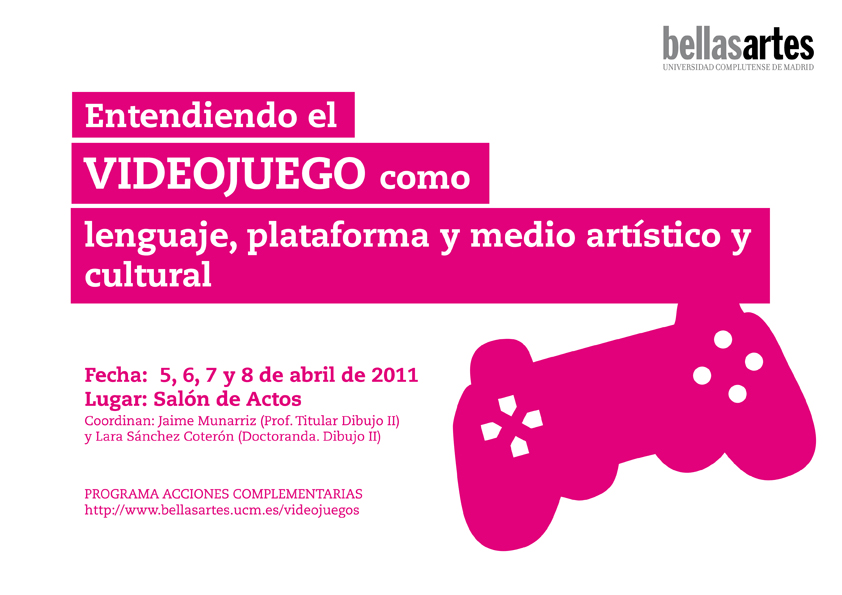
Dentro de ese espacio de experimentación paralelo yo contribuí en 2011 con unos seminarios denominados «Entendiendo el videojuego como lenguaje, plataforma y medio artístico y cultural» que tuvieron lugar entre el 5-8 de abril.
Martes, 5 de abril 2011
10.00 h – 15.00 h:
– 2.1 Introducción: contexto histórico, el juego y el elemento lúdico en la cultura artística contemporánea.
– 2.2 Introducción al Game Art, el videojuego y las prácticas artisticas. Miércoles, 6 de abril 2011
10.00 h – 15.00 h:
– 2.3 Juegos independientes, propuestas desde fuera de la industria.
– 2.4 Juegos experimentales, proyectos de innovacion e investigación. Jueves, 7 de abril 2011
9.00 h – 14.00 h:
– 2.5 Games with Social/Political Agenda, insertando la realidad en los entornos lúdicos.
advergames. Edutainment y Games-Based Learning. News games. Simulation games. Games for health. Viernes, 8 de abril 2011
10.00 h – 15.00 h:
– 2.6 Introducción a las nuevas interfaces.
Nuevas Interfaces: Juegos geo-localizados y fuera de pantalla. Interfaces físicas, gestuales y hápticas. Realidad aumentada. Pervasive games.
– 2.7 Experiencias expositivas de Game Art.
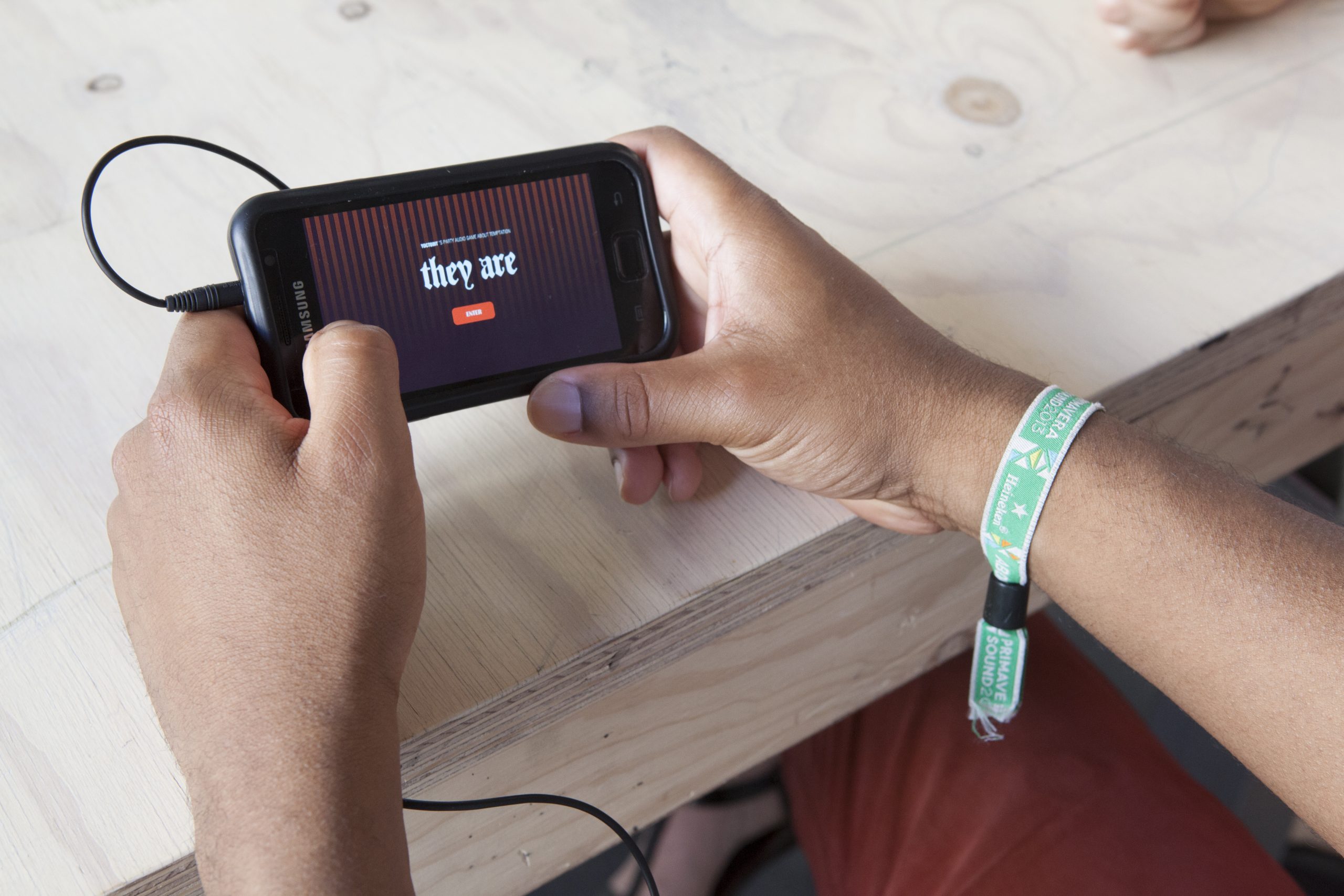
THEY ARE is a local multiplayer, for android devices. The main mechanic of the game is finding the balance between yielding to the temptation and chasing other player’s weaknesses. This is mainly an audio game although is also a physical one.
This party audio-game was one of the finalist of the Bosch Art Game International Contest together with other five studios; Tjupakabra (Amstelveen, Netherlands), We Are Muesli (Milan, Italy), Espada y Santacruz (Madrid, Spain), Urustar Srl (Genova, Italy) and Brian S. Chung & GJ Lee (Jersey City, USA).
The jury was an international one consisting of five member related with the indie games scene, such as Brandon Boyer, chairman of the Independent Games Festival and founder of video game culture site Venus Patrol (USA), Ed Key indie developer of games such as Proteus (UK), Margaret Robertson, development director for Hide&Seek (UK), Zuraida Buter, co-director of the Global Game Jam and initiator of the first Dutch indie game showcase festival Indigo (the Netherlands) and Adriaan ’s-Gravesande (the Netherlands), artistic manager of Jheronimus Bosch 500 Foundation.
First playtesting session and shooting at Medialab Prado Madrid. June 27th, 2013.
NARRATIVE INTRODUCTION In a world of shades, do you dare to open your eyes? Tiny creatures are trying to exhort you with right and wrong advices. Will you follow their hints, or listen to your inner voice?
They Are is a local multiplayer audio game of intuition and reflexes, about temptation, inspired on Hieronymus Bosch’s fancies and imagery. Although on his time Bosch’s paintings were well accepted as expressions of devotion, later on, the spanish Inquisition ticked them as heretic works. From an ucronic contextual starting point in which Bosch and spanish Inqusition clashed to each other, we will set up an experience in which players must find the balance between yielding to temptation and chasing other player’s weaknesses.
Through audio landscapes and spoken-voice characters the game provides enough sources to the player to create some enigmatically beautiful imagery and enjoy some sort of arcane experience. The action is driven by audio cues that come up from the mobile to each player’s headphones, but the game actually happens in the physical space out of the devices, and mainly in the players’ minds.
Although each player plays against everyone else, every decision the player takes could affect himself positively or negatively in the long term, because in THEY ARE fate is reversible.
You can listen to some soundscapes Felipe Hickmann did from different stages of the playful experience here.
El archivo ejecutable APK para dispositivos móviles Android del audio-juego multijugador local THEY ARE puede descargarse de manera gratuita desde el repositorio GITHUB bajo licencia Creative Commons CC0 1.0 Universal: https://github.com/UnityForDesigners/TheyAre/blob/main/README.md
Los audios de la banda sonora original, creada por Felipe Hickman para el juego, están disponibles en acceso libre y versión íntegra, bajo licencia Creative Commons CC BY SA 4.0 Internacional en el repositorio Soundcloud:
Game Objective: In early prototypes all players start with 0 points. The first to reach 30 points wins. Not meaningful diegetic objectives yet.
One of the players creates a game session in his device.
The other players, whose devices must be using the same wifi network, connect to the game session and get an ID number. The player that created the session confirms the game when everyone has connected.
Once this is done, each player puts on her headphones, which are connected to the device, and the game begins the moment all players have tapped the ‘Start’ button on their screen and closed their eyes.
Players must keep their device in their hand until the game ends, and hidden from the other players, like in their lap or under the table, for example. Players will have their eyes closed and their headphones on for the most part of the game.
Temptation Stage
Keywords: delight, fun, laughter, sensual, forbidden, garden, party
The game always begins in this stage. To earn points, players have to catch other participants with their eyes open and react faster than them.
Players can open and close their eyes at any time.
When a player (the hunter) detects another player (the prey) with his eyes open:
– Hunter must quickly tap in his device’s screen on the ID number of the person with open eyes.
– Prey will do exactly the same and opposite (tap the hunter’s ID number), because the first to tap wins, but let’s imagine the hunter is faster this time
– The prey has to confirm in his device that he has been caught
– Hunter receives 3 points. Prey loses 1 point, unless prey has 0 points in which case no points are subtracted.
Through their headphones, besides the background piped music, each player will hear random sentences from distinct groups of voices.
-BOSCH’S ESPRITS both introducing the players to a fantasy world and giving them an avatar profile which also will make them to perform. Examples:
“Move your wings up and down. Move your wings up and down, you are trying to raising but your silver scales are too heavy”
“shake your head. shake your head, lots of little tiny red creatures, not bigger than a pearl are going up from your sharp shoe until your long bristles crest. you can’t neigh”
-INQUISITION GHOSTS with unnerving voices spiting commands, harshing criticisms, or teasing the players to be more daring. This makes the game system explicit and entice players to open their eyes. Examples:
“Hey look!, Player on your left is acting weird ”
«Now or never! Open your eyes, they are all distracted!»
«YOU-MUST-WIN!»
«The player in front of you is so clumsy! I laugh in his face: Ha-Ha!»
«I’ll sit here and watch your pitiful defeat»
“Do you think you are being watched by others?”
Besides, along with the background music, occasional laughter is heard from time to time through the headphones. We will also try to provoke laughter in the players with some audio cues, so that the headphones laughter gets mixed with real laughter from other players.
The characters heard by the player will suggest:
– Lick your lips as if you were tasting the most fabulous chocolate cake
– Put a finger inside a nostril (“Nobody is looking! Do it, you know you want to…”)
– Smile with the mouth wide open
– Put the weirdest facial expression you can achieve, as if you were alone doing it for fun in front of the mirror
This means that when a player opens her eyes to try to hunt someone else, she will find a bunch of people doing silly things which- hopefully – make her to laugh (and easier to hunt).
Also, the voices would suggest to do some actions which emit some loud noise:
– Do as if they were snoring
– Make funny noises with the mouth
– Pant and gasp as if they were having sex
– Sing anything
These leads to a strategy of luring ‘victims’ into opening their eyes by making the strangest noises, and trigger a hunt.
The more the game advances, the more frequent the voices will be heard. The two group voices can also start arguing with each other, or even overlap.
The more points a player has, the more annoying, loud and frequent the voices are heard.
Players do never hear the same at the same time. Each player hears different sentences at different times.
If none of the players taps any name for 20 or more seconds, the game will ask a random player to open his eyes – and he can obey or not. The other players are told that someone has been forced to open his eyes.
Punishment Stage
Keywords: severity, fear, penance
In this stage, one of the leading players risks losing his device – and with it, his score.
Randomly every 2-3 minutes, the game chooses randomly one player among the 3 ones currently leading. The chosen player has to:
– Select on the screen which player will be faster
– Unplug his headphones, leave his device in the center of the table, and tap the screen
At this moment, all the other players are informed that:
– There’s a device in the center of the table, owner unknown
– They’ll hear a countdown
– When the countdown ends, they must open their eyes and tap in their screens the name of the deviceless player
The mobile in the center of the table will ‘speak’ aloud the name of the faster player.
If the deviceless player guessed correctly who would be faster, he recovers his device.
If the deviceless player failed his prediction, swaps his mobile with the faster player.
Shuffling Stage
At some point every 4-5 minutes, the game asks two or more players to open their eyes and swap positions in the table.
Sometimes these swaps are meaningful (for example, to put the best two players in front of each other), and sometimes purely random. The players never know the reasons of the commanded swaps.
The score system in the game is designed to favour the worst performing players, so that there’s never a huge score difference between the best performing and the worst.
Silently forcing punish and shuffling stages so the best performing players either lose points, their device, or change their position, will help take the game to a close finish, in which many players will be close to win, making the outcome more thrilling and unexpected.
YOCTOBIT MEMBERS GAME DESIGN: Nacho Pintos & Lara Sánchez Coterón SOUND & MUSIC: Felipe Hickmann DEVELOPMENT: Rubén García Moreno
B.1.3 CALIDAD Y DIFUSIÓN DEL PROYECTO ARTÍSTICO: ITINERANCIA EXPOSICIONES, PRESENTACIONES NACIONAL Y UBICACIONES INTERNACIONALES
-Presentación por parte de los/as autores/as de los prototipos seleccionados para el patronato de la Fundación Jheronimus Bosch 500, en ‘sHertogenbosch, Holanda. 1 y 2 de agosto de 2013
-Presentación, muestra pública oficial y encuentro con los/as autores/as de los seis finalistas en el Museo de Arte Contemporáneo y Diseño Stedelijk en ‘sHertogenbosch, Holanda. 11, 12 y 13 de octubre 2013.
-Muestra de los seis prototipos finalistas en la 8ª edición del Festival Game City en Nottingham, Reino Unido. 22 y 23 de octubre de 2013.
-Presentación de los seis prototipos finalistas en la feria Italian Game Developers Summit, Milán, Italia. 25 de octubre de 2013.
-Muestra de los seis finalistas Bosch Art Game en la 9ª edición del Festival SHARE, Real Time, Real Space. Turín, Italia. Del 30 de octubre al 9 de noviembre de 2013. Video de la inauguración https://youtu.be/_voNQHljVk4?si=J_rRQ_oNanEMtWKJ
B.1.4 CALIDAD Y DIFUSIÓN DEL PROYECTO ARTÍSTICO: PUBLICACIONES EN MEDIOS Y PRENSA
-Reportaje «Pensamiento digital» especial edición nº 137 Revista El Duende -Reportaje en periódico holandés Brabants Dagblad. (07/08/2013) -Entrevista a Iris Peters por el crítico de game art Matteo Bittanti en su blog Game Scenes. (15/12/2013)